 Image 1 of 1
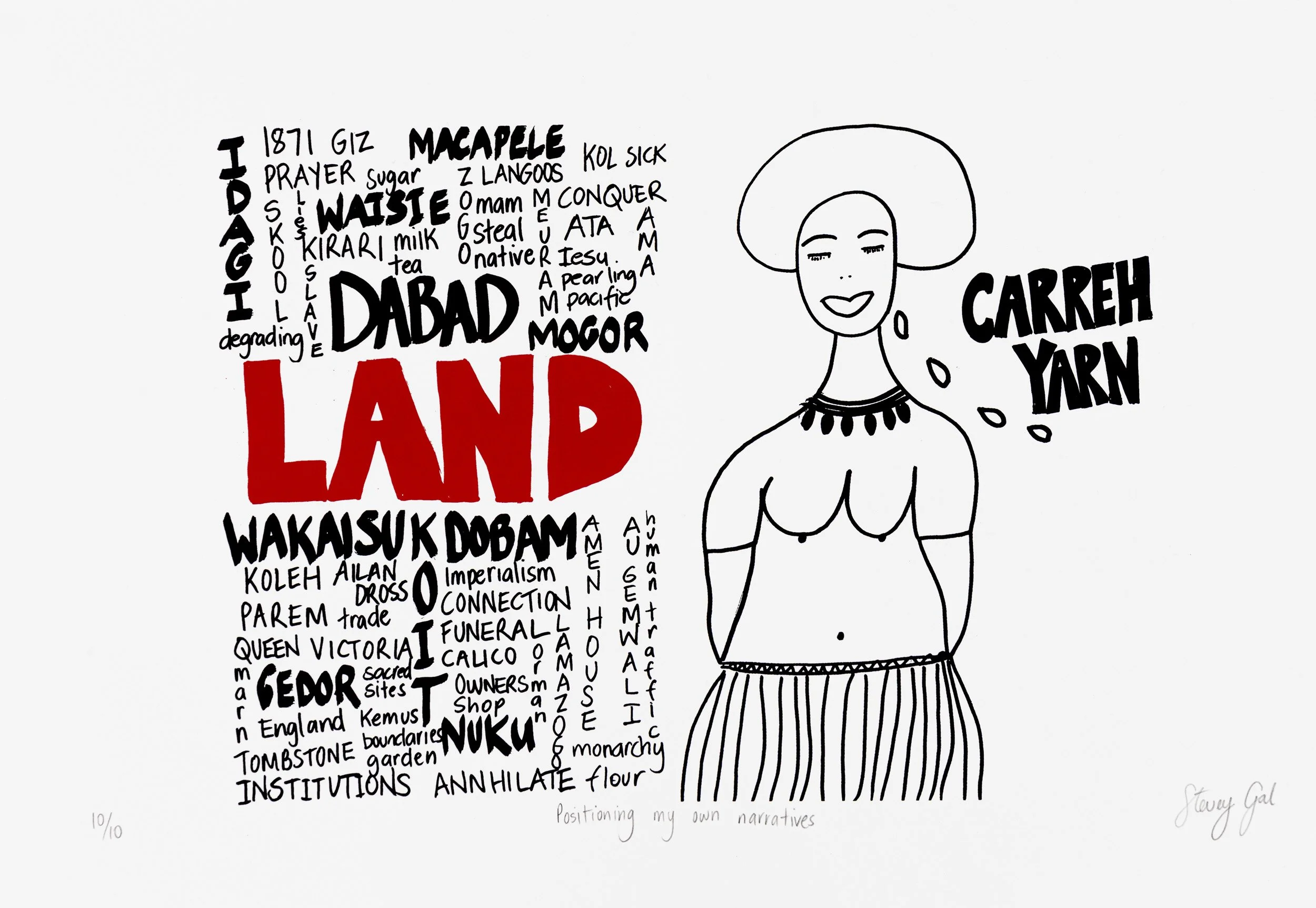
Positioning My Own Narrative, 2026
2 AP, Edition of 10
380mm x 560mm
Silk screen print on somerset
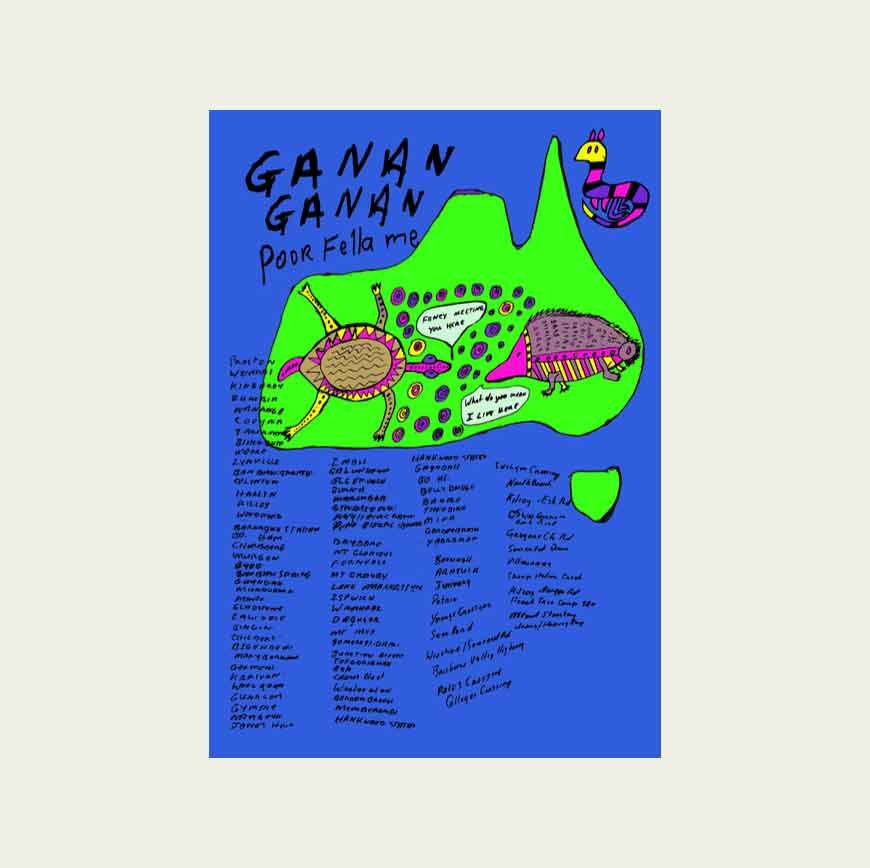
Every social or political fight concerning my people has always come back to the concept of Land. Land from a western lens is about gaining power and having full ownership over land, whether it be through force, bloodshed or colonisation. The notion of Land since pre colonisation and post colonisation, captures many different elements associated to the land; genealogy, ancestry, sacredness, landmarks, boundaries, historical accounts, massacres, dispossession, violence, burial, stori ples, or zogo areas.
The words surrounding Land in my artwork make up many different narratives associated with my identity, family, history, world views and how my people and ancestors lived before and after colonisation. My artwork also aims to explore our lands as first nations people, before our lands became part of the colonial and political agenda; and how it continues to gain wealth for the British crown and monarchy.
Sylvia Nakachi is a descendant from the Eastern Islands of Erub in the Torres Strait, with blood ties to Yupangathie aboriginal peoples from Western Cape York. Nakachi grew up in Bamaga, a remote indigenous community, on Cape York Peninsula. Bamaga is also one of five indigenous communities that make up the Northern Peninsula Area (NPA). Sylvia has a Doctor in Philosophy (PhD) from Batchelor Institute, her thesis titled ‘Erub After 1871 – decolonising the colonial narrative within my Erub world views and perspective as an Erub woman’. Sylvia’s work captures concepts of how her Erub people have been influenced under imperialism and the Victorian Era, and how her people have adapted and transitioned throughout post colonialism. Nakachi focuses on several concepts in her work, to bring new knowledge into research, as she decolonises practices on: Ailan (island) Tombstone Unveiling, Funeral Practices, The Erub Woman, Language and Dabad. Nakachi has dedicated part of her research to her ancestor Dabad, who played a pivotal role in the history and narratives of Erub during pre-colonisation and when the London Missionaries arrived at Kemus on 1 July 1871. Nakachi’s work decolonises her ancestor’s narratives through her own world views and from her family’s oral histories. Her research was to give her ancestor Dabad character, personality, and to capture his life through her Erub’s world views. Nakachi has showcased her work in several art exhibitions around Brisbane and during the Commonwealth Games on the Gold Coast. Nakachi’s 2017 art exhibition, Iesu ra mir giz ge omaida Mer ge bazarida igaire Torres Strait receive a joint award at the Queensland Gallery and Museum Achievement Awards for Engagement – Organisation with Paid Staff. Sylvia has also taught in several educational institutions and schools around Brisbane. Where she has taught Torres Strait Islander cultural studies and embedding the indigenous perspective through the educational curriculum. Nakachi is also a passionate child advocate and indigenous advisor, who has many years of experience advocating for better educational needs and resources in Logan City public schools.
Positioning My Own Narrative, 2026
2 AP, Edition of 10
380mm x 560mm
Silk screen print on somerset
Every social or political fight concerning my people has always come back to the concept of Land. Land from a western lens is about gaining power and having full ownership over land, whether it be through force, bloodshed or colonisation. The notion of Land since pre colonisation and post colonisation, captures many different elements associated to the land; genealogy, ancestry, sacredness, landmarks, boundaries, historical accounts, massacres, dispossession, violence, burial, stori ples, or zogo areas.
The words surrounding Land in my artwork make up many different narratives associated with my identity, family, history, world views and how my people and ancestors lived before and after colonisation. My artwork also aims to explore our lands as first nations people, before our lands became part of the colonial and political agenda; and how it continues to gain wealth for the British crown and monarchy.
Sylvia Nakachi is a descendant from the Eastern Islands of Erub in the Torres Strait, with blood ties to Yupangathie aboriginal peoples from Western Cape York. Nakachi grew up in Bamaga, a remote indigenous community, on Cape York Peninsula. Bamaga is also one of five indigenous communities that make up the Northern Peninsula Area (NPA). Sylvia has a Doctor in Philosophy (PhD) from Batchelor Institute, her thesis titled ‘Erub After 1871 – decolonising the colonial narrative within my Erub world views and perspective as an Erub woman’. Sylvia’s work captures concepts of how her Erub people have been influenced under imperialism and the Victorian Era, and how her people have adapted and transitioned throughout post colonialism. Nakachi focuses on several concepts in her work, to bring new knowledge into research, as she decolonises practices on: Ailan (island) Tombstone Unveiling, Funeral Practices, The Erub Woman, Language and Dabad. Nakachi has dedicated part of her research to her ancestor Dabad, who played a pivotal role in the history and narratives of Erub during pre-colonisation and when the London Missionaries arrived at Kemus on 1 July 1871. Nakachi’s work decolonises her ancestor’s narratives through her own world views and from her family’s oral histories. Her research was to give her ancestor Dabad character, personality, and to capture his life through her Erub’s world views. Nakachi has showcased her work in several art exhibitions around Brisbane and during the Commonwealth Games on the Gold Coast. Nakachi’s 2017 art exhibition, Iesu ra mir giz ge omaida Mer ge bazarida igaire Torres Strait receive a joint award at the Queensland Gallery and Museum Achievement Awards for Engagement – Organisation with Paid Staff. Sylvia has also taught in several educational institutions and schools around Brisbane. Where she has taught Torres Strait Islander cultural studies and embedding the indigenous perspective through the educational curriculum. Nakachi is also a passionate child advocate and indigenous advisor, who has many years of experience advocating for better educational needs and resources in Logan City public schools.